



In Kuwait, understanding how heat affects your electric vehicle (EV) is essential for maintaining performance and reliability. Elevated temperatures on common days influence everything from battery efficiency to charging behaviour, and even the vehicle’s overall lifespan.
Unlike conventional engines that convert fuel into motion, EVs’ performances depend on battery chemistry and precise electronic systems. When exposed to high heat, these systems can experience reduced energy efficiency, accelerated battery wear, and increased strain on the cooling system.
But technology is evolving quickly — and so are solutions designed for these climates. This article explains how high temperatures affect EV performance and introduces new thermal control and battery innovations that help modern electric vehicles operate safely and efficiently, even under intense heat.
Why Extreme Heat Influences EV Performance?
Every electric vehicle battery operates best within a certain temperature window — typically between 20°C and 30°C. Within this range, the battery’s internal chemical reactions occur efficiently, delivering optimal power output and energy storage capacity. When temperatures rise far beyond this limit, however, those reactions speed up excessively, putting extra stress on the battery cells.
High heat is one of the major enemies of battery longevity. Elevated temperatures accelerate the breakdown of electrolytes — the liquid that allows ions to move between the anode and cathode — leading to chemical imbalances inside the cell.
Over time, this speeds up what engineers call capacity fade, meaning the battery can hold less charge than before. It also increases internal resistance, reducing efficiency and shortening the driving range.
In simpler terms, constant exposure to high temperatures ages the battery faster. Drivers may notice a gradual drop in range or longer charging times — early signs of thermal degradation.
How Heat Impacts Your Daily Driving Experience?
High temperatures don’t just affect the technical side of EV performance — they also influence your day-to-day driving experience. From range to electric car charging behaviour and long-term reliability, heat can subtly change how your vehicle performs and feels on the road.
1. Reduced Driving Range
When the battery gets too warm, the EV’s energy management system automatically diverts power to cooling functions to prevent overheating. This means less energy is available for propulsion, reducing your driving range. Additionally, higher battery resistance under heat conditions lowers overall energy efficiency, meaning your EV may consume more power to travel the same distance.
2. Slower Charging Speeds
Fast charging generates heat, and if the ambient temperature is already high, your EV’s battery control system will reduce the charging rate to protect the cells. As a result, charging sessions may take longer, especially at DC fast chargers. While this safeguard prevents thermal damage, it can be inconvenient when you need a quick top-up in hot weather.
3. Long-Term Battery Health
Repeated exposure to high temperatures gradually accelerates battery wear. Even if you don’t notice immediate changes in range or charging, prolonged operation in heat contributes to permanent capacity loss. Over the years, this can lead to shorter range per charge and lower resale value.
How Drivers in Hot Climates Can Protect EV Performance?
Even in high-temperature environments like Kuwait, there are practical ways to preserve EV performance and battery health. Small driving and charging habits can make a big difference in keeping your vehicle efficient, safe, and long-lasting.
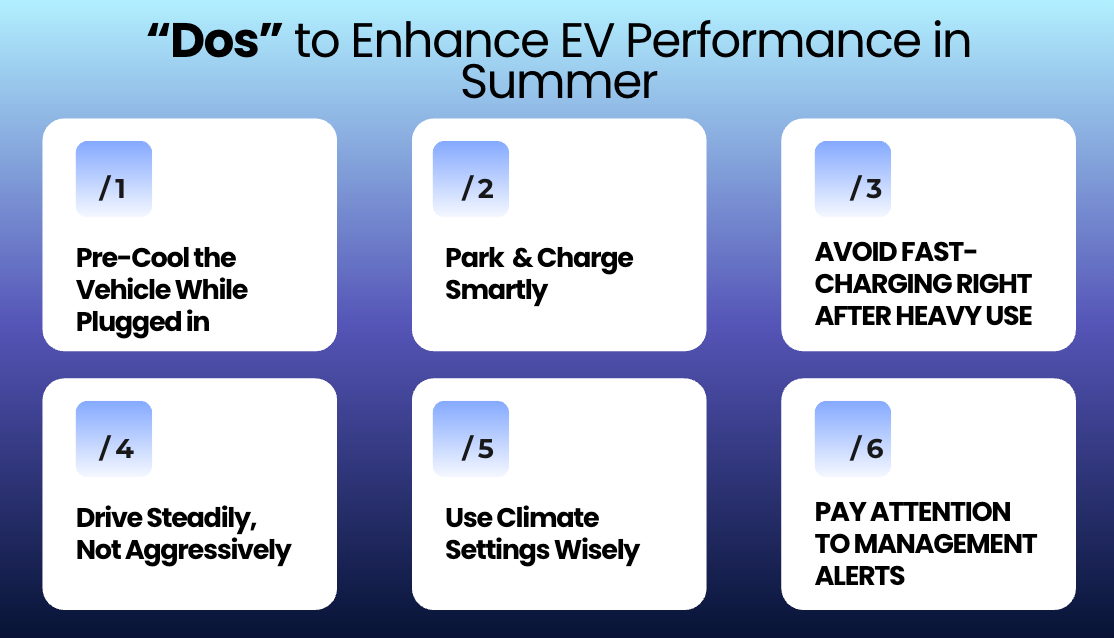
1. Pre-Cool the Vehicle While Plugged in
Before you start your trip, cool down the cabin while the car is still charging. This allows the air-conditioning system to draw power from the grid rather than the battery, helping maintain EV performance and preserving range once you’re on the road.
2. Park Smartly
Parking in shaded areas or cool garages reduces the battery’s exposure to extreme heat. If shade isn’t available, use reflective windshield covers to minimize interior temperature buildup. This simple step helps your car’s cooling system work less, improving overall EV performance efficiency.
3. Avoid Fast-Charging Right after Heavy Use
After long drives or highway runs, your battery is already warm. Plugging into a fast charger immediately can raise the temperature further, stressing the cells. Letting the vehicle rest for a while helps the system stabilize and protect EV performance over time.
4. Drive Steadily, Not Aggressively
Frequent hard acceleration generates more heat inside the battery and motor. Smooth, steady driving not only extends range but also supports consistent EV performance, especially in high-temperature regions.
5. Use Climate Settings Wisely
Your A/C can significantly affect energy consumption. Use the “recirculate” mode to keep cool air cycling efficiently and avoid setting the temperature excessively low. Smart climate control helps balance comfort with EV car performance optimization.
6. Pay Attention to Battery Management Alerts
Modern EVs are equipped with intelligent monitoring systems that alert you when temperature or charging conditions are not ideal. Follow these warnings and adhere to the manufacturer’s recommendations to sustain your car’s EV performance and battery lifespan.
7. Schedule Charging for Cooler Hours
Whenever possible, charge your EV during the early morning or late evening. Lower ambient temperatures mean faster, safer charging and improved EV performance in the long run.
In the End
High temperatures are an unavoidable reality in Kuwait and similar regions, but they don’t have to compromise your EV performance. By understanding how heat affects batteries and adopting smarter driving and charging habits, you can maintain both efficiency and longevity.
At the same time, technology is evolving to meet these challenges head-on. GAC’s Magazine Battery 2.0 represents a major breakthrough in heat resistance and energy stability. With its super heat-resistant layer, superior insulation performance, and enhanced electrode interface, this next-generation EV battery minimizes the risk of short circuits and maintains consistent performance even under extreme temperatures in upcoming EVs of GAC Kuwait.
Further reading:
GAC's new generation battery is designed to withstand severe temperatures with unmatched stability and safety. Its super-stable interface electrode maintains chemical balance even under high thermal stress, while the super-heat-resistant layer, with resistance up to 2,000 °C, drastically reduces the likelihood of internal short circuits in the cells. This means that even on extremely hot days, the system maintains optimal performance without compromising battery integrity.

In addition, Magazine Battery 2.0 incorporates a cell-based fire extinguishing system designed for extreme situations. If an explosion or overheating does occur, the system automatically activates, with an ultra-thin, millimetre-precise extinguishing plate that locates and sprays the exact point of the problem. The result is a quick and effective response, supported by insulation 2.3 times stronger than ordinary nitrogen, ensuring that the incident is contained before it spreads.
To learn more about GAC Magazine Battery 2.0 technology and other GAC’s innovations in EV power, visit /en-kw/technology/engine-and-battery.